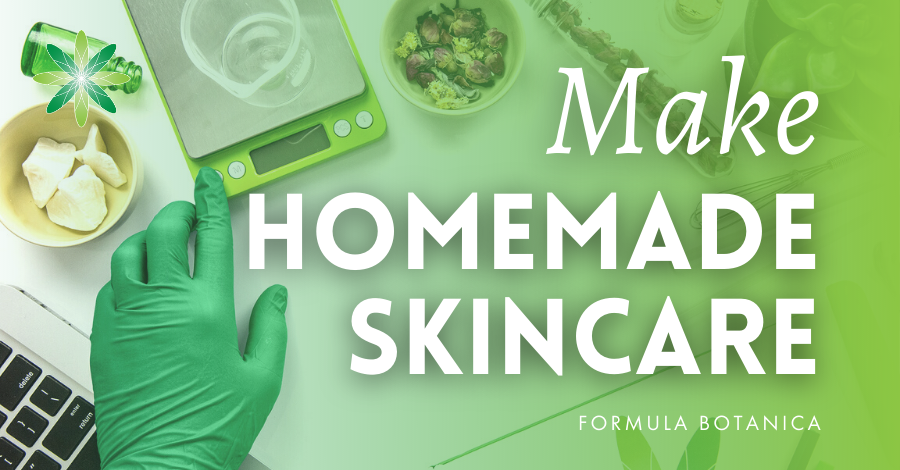
Think your kitchen is clean enough for making skincare? Think again.
I was speaking to a Formula Botanica student the other day who told me that when she first started formulating, she did it from her kitchen, with her kids running around and the dog going in and out.
As you can imagine, everything felt a little chaotic – but at first, she didn’t think much of it.
But as she enrolled in our award-winning formulation courses and started learning more about skincare safety and how to make skincare safely at home, she realised her space wasn’t quite set up in a way that would give her consistent, safe results.
And she’s not alone. At Formula Botanica, the world’s leading online organic cosmetic formulation school, we speak to so many people who aren’t sure if their kitchen is hygienic enough to make skincare in or how to even safely make DIY skincare at home.
The good news? With the right approach, your kitchen can absolutely become a safe, effective space for making professional-grade skincare at home – and I’ll show you exactly how in this post.
What can go wrong if your kitchen isn’t clean enough?
Before we get into how to clean and prep your kitchen space so that it’s truly suitable for making skincare in, let’s take a look at what could go wrong if your setup isn’t quite there yet.
This isn’t to alarm you. It’s simply to help you understand why proper hygiene – and following Good Manufacturing Practice (GMP) – matters when making skincare products.
And this doesn’t just apply to making DIY skincare at home. These are the same principles followed by professional formulators in cosmetic labs around the world.
Risk #1: Microbial contamination
The first (and biggest) risk of an unclean kitchen or production space is microbial contamination.
If your kitchen or equipment isn’t properly cleaned and prepared, you risk contaminating your skincare products. Even if everything looks fine, microorganisms can still be present and affect the safety and quality of your formulation. In some cases, this can lead to irritation or spoilage.
And here’s the even scarier thing: contamination is often completely invisible. Your products might look and smell perfectly fine, yet still not be safe to use.
This is where many beginners get caught out.
The good news? This is entirely preventable with the right setup and cleaning routine!
Risk #2: Product instability
Next, if your kitchen or production space isn’t properly cleaned and sanitised, you also risk product instability. But what does this mean?
In simple terms, this means your products may not hold up over time. They might not look, smell, feel, or perform the same way throughout their shelf life. You might notice:
- Separation
- Changes in colour or scent
- Shifts in texture or skin feel
Environmental factors like temperature, humidity, and cleanliness all play a role here. For example, you might have just finished prepping your lunch, and your kitchen is still warm and humid from the steam, and there might still be traces of your food present, even if you cleaned up after. All this could easily lead to contamination (visible or not).
Again, this is something you can manage. And it starts with having a clean, well-prepared production space, which can absolutely be your kitchen!.
Risk #3: Legal & safety risks
Finally, if you plan on making and selling your own skincare products from home (which, by the way, is amazing, and is how many award-winning beauty brands start out), cleanliness becomes even more important.
If your production/formulation space isn’t properly set up, you risk producing products that aren’t safe or stable. And that can:
- Damage your brand reputation
- Erode customer trust
- And potentially lead to regulatory issues!
In many parts of the world, there are guidelines you need to follow when making or selling cosmetic products, and you can learn more about this topic in the post below:
Even if you’re only making products for personal use, following these guidelines is still strongly recommended. They help you build safe habits from the start and give you confidence in what you’re creating.
In the next section, I’ll introduce these guidelines and explain how they help ensure your products are safe.
A quick note about GMP (And why it matters)
Luckily, there is a way to reduce all the risks we’ve just talked about – and that is by following GMP.
GMP stands for Good Manufacturing Practice. It’s a set of guidelines used across the cosmetics industry to ensure products are made safely, consistently, and to a high standard.
All professional formulators follow GMP when making skincare products. And if you want to make safe, professional-grade skincare, you should follow these principles too. This helps you:
- Reduce the likelihood of microbial contamination
- Improve product stability
- Avoid unnecessary legal and safety risks
- Create consistent, reliable, and effective cosmetic products
- Build confidence in your process
In short, it helps reduce all the risks we’ve just talked about and gives you peace of mind when using, sharing, or selling your skincare products.
And the first step in complying with GMP is – you might have guessed it – having a clean and sanitised home lab/production space.
How to clean your kitchen so it’s safe to make skincare in it
Now that you understand the importance of a clean home lab/production space when making skincare products, let’s look at how to actually prepare and clean your kitchen for formulation.
This is really simple. You don’t need a sterile lab or professional setup to make DIY skincare safely at home. You just need a clean, clear, and sanitised home lab/workspace, which can absolutely be your kitchen!
Step 1: Clean your workspace with hot water and soap
Start by clearing a dedicated counter space or table in your kitchen (or another suitable area in your home).
Then clean your chosen surface, along with your equipment and tools, using hot water and soap. Allow everything to air-dry, or dry with a clean paper towel. If you have a dishwasher, you could also run your glassware through a hot cycle.
Step 2: Sanitise everything with 70% alcohol
Once everything is clean and fully dry, the next step is to sanitise your home lab/workspace and tools. Spray your work surface and equipment with 70% isopropyl alcohol or ethanol, then allow everything to air-dry or wipe with a clean paper towel.
You can easily find 70% alcohol online or in most supermarkets.
As our Formulation Tutor, Anneke, puts it:
“70% isopropyl alcohol spray and paper towels are your best friends when it comes to sanitising kitchen counters. Just spray the surface and wipe it down. I also like to lightly spray the paper towel itself before wiping, so you’re left with sanitised countertops every time, ready for formulating.”
The reason for using 70% alcohol rather than 80%, 90%, or 99% is simple. Higher concentrations evaporate too quickly to destroy microbes effectively, whereas the water content in 70% alcohol helps it penetrate cell walls and denature proteins more effectively, making it more efficient for sanitisation (basically, it helps kill microbes more efficiently).
And that’s it. You now have a clean, sanitised, safe space to make your skincare products, and are now compliant with the first step of GMP. Easy, right?
Sanitisation, disinfection, sterilisation: what’s the difference?
Before we move on to the team’s top tips for setting up your home lab, let’s quickly clear up something that often causes confusion, even within DIY and professional formulation circles: the difference between sanitisation, disinfection, and sterilisation.
These terms are frequently used interchangeably, but don’t mean the same thing.
Sanitisation
Sanitisation reduces microorganisms to levels considered safe for general use. It doesn’t make something completely germ-free, but it lowers the risk enough for safe handling – which is exactly what you need for home formulation.
And it’s what you already do in daily life without even realising it: washing dishes, wiping down kitchen surfaces, cleaning countertops, and other general home cleaning routines.
Disinfection
Disinfection goes one step further. It destroys or inactivates most bacteria, fungi, and pathogens, but not their spores. So while it significantly reduces risk, it still doesn’t create a completely sterile environment.
It’s typically used in higher-risk environments like healthcare settings.
Sterilisation
Sterilisation is the highest level of microbial control. It destroys all forms of microorganisms, including spores, leaving a completely germ-free surface or object.
This is critical in medical settings like hospitals or when preparing certain pharmaceuticals, but it is not required for making skincare at home. You can sterilise some of your equipment if you wish, but it’s not strictly necessary.
In fact, many people talk about having a “sterile” workspace without truly understanding what that means. And the truth is that achieving sterility in a formulation workspace, however fancy or expensive, will never be achievable.
As mentioned above, to make or sell skincare at home, you only need to clean and sanitise your workspace and equipment. We teach you everything you need to know about setting up your own GMP-compliant formulation space and proper procedure for making safe and effective skincare in our award-winning foundation Diploma in Organic Skincare Formulation.
What you need for your home lab setup
To sum up, when it comes to your home formulation lab setup, cleaning and sanitising your workspace is more than enough.
Sterilisation is only used in medical settings (mostly hospitals) – not in home skincare formulation. Yet many people believe they need a completely sterile environment to make skincare safely.
Somewhere along the way, sterilisation and sanitisation got confused in the beauty space. As a result, a lot of aspiring formulators assume they can’t make skincare safely at home.
At Formula Botanica, we’ve spent years unpicking this myth and showing people that, with the right approach, setting up a home lab and making safe and effective skincare from home is absolutely possible.
Bonus tips from the Formula Botanica team
To wrap up this post, I asked the Formula Botanica team for their best tips on setting up a formulation space at home. Here’s what they had to say.
Formulating from your kitchen
First, all team members agreed that you can make and sell skincare products from your kitchen – as long as it’s clean and sanitised.
Many of our students start this way. And as they progress, some of them choose to set up a dedicated lab space in their home, but it’s not necessary at the beginning.
In fact, our Formulation Tutor, Anneke, shared a powerful story about a South African skincare brand that started in exactly this way.
During COVID, the founder began making simple, affordable serums after noticing how expensive and largely imported skincare products were at the time.
A few years later, that same brand now has its own manufacturing facility, an expanded product range, and multiple retail stores. It has built a strong online presence and even exhibited at major industry events like Cosmoprof in Bologna. And it all started in a kitchen.
Stories like this aren’t unusual or isolated cases. Many Formula Botanica graduates started exactly the same way – formulating at home, often in their kitchens – before going on to build successful and award-winning natural skincare and haircare brands.
If you’re interested in learning more about how to set up your own budget-friendly home lab and reading some of our graduates’ success stories, check out these posts:
How to set up your home formulation lab
Creating a simple setup that works for you
I also asked our Cosmetic Scientist, Natalie, what her formulation space looks like at home, and she keeps her setup simple and practical.
She stores all of her equipment and ingredients in stackable closed storage boxes and uses a stain-resistant and height-adjustable polyethylene table as her work and formulation surface:
“I do all my work and formulation on this table. It’s great because I can move it wherever I need, and it doesn’t come into contact with other surfaces. I often keep it in my living room and fold it away when I’m finished. Before I start, I sanitise it with 70% isopropyl alcohol and wipe it down with a paper towel.“
It’s a simple but highly effective setup you can easily replicate at home, and a great reminder that you don’t need a sterile environment or complicated setup to get started!
Consistency is key
Natalie also emphasised the importance of consistency when making skincare products – another core part of GMP.
Choose a dedicated workspace and stick to it, whether that’s in your kitchen, your desk, or a foldable table like Natalie’s. Then follow the same cleaning and sanitisation routine every time you formulate. If using a sponge or cloth, keep the same one just for your cleaning routine, or use disposable paper towels.
To recap, to clean and prep your formulation space, you need to:
- Clean your chosen workspace with hot water and soap
- Sanitise it with 70% alcohol
- Allow it to air-dry or wipe it down with a clean paper towel
These small habits make a big difference over time and will get you into the flow of formulating GMP-compliant skincare products.
If you enrol with us at Formula Botanica, you’ll also learn about other key GMP practices – such as avoiding double-dipping to prevent cross-contamination – so you can safely make, use, share, and even sell your skincare products from home.
Learn how to make skincare safely at home
Hopefully, you now understand the importance of a clean and sanitised workspace when making GMP skincare safely at home – and how simple it actually is to get started.
You don’t need a sterile lab or professional facility to follow GMP. You just need:
- A dedicated workspace
- A simple cleaning routine
- And a consistent process
You now know how to successfully prepare your space to make skincare safely at home. The next step is knowing what to do in it – and that’s exactly what we teach in our free training and foundation Diploma in Organic Skincare Formulation, which is our award-winning cosmetic formulation course.
Thousands of graduates started where you are, in their kitchens, and went on to build professional brands. Your space is ready. Are you?
FREE TRAINING
Learn how to become an
Organic Skincare Formulator
FREE TRAINING
How to become an
Organic Skincare Entrepreneur
FREE TRAINING
How to become an
Organic Skincare Entrepreneur


Ariane is Formula Botanica’s Content Creator and an active member of the student community. She has worked as a professional journalist, blogger, copywriter and editor before joining Formula Botanica full-time in 2024.